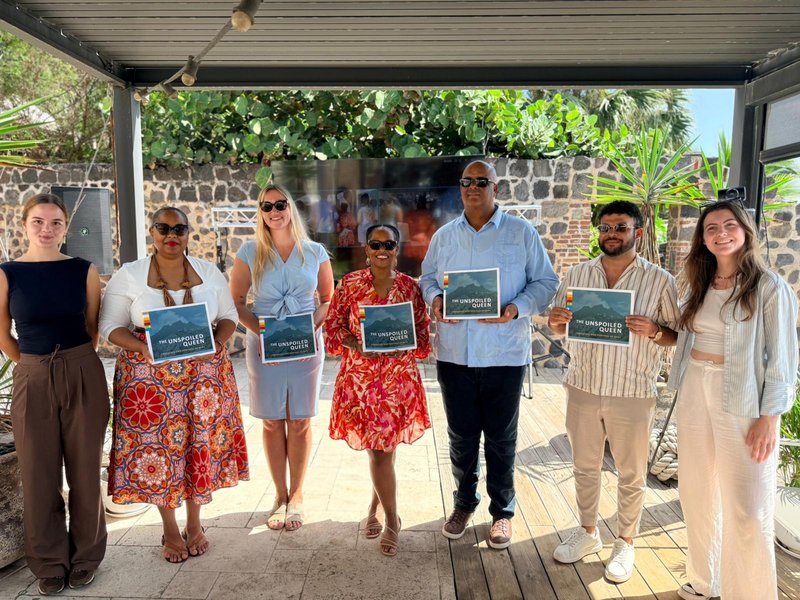


The gathering linked physical audiences on St. Eustatius and Amersfoort, with online viewers, and brought together policymakers, heritage experts and cultural partners and the public to reflect on the shared but distinct histories of the two islands and the importance of protecting our treasured heritage. Commissioner Heyliger was also accompanied by Deputy Island Secretary Michelle van Duin, Executive Assistant Jayaira de Groot-Windfield and Education & Culture Policy Advisor Shaigan Marten.
During the symposium, Commissioner Heyliger was presented with the first copy of the Landscape Biography of Saba by Sharifa Balfour, Director of the Saba Archeological Center Foundation (SABARC)/ Saba Heritage Center. The biography was commissioned by the Public Entities of Saba and St. Eustatius and led by the RCE and serves as a formal record of how Saba’s landscape and community have evolved together over time, connecting various aspects of geology, ecology, maritime activity and social building into one coherent narrative.
The full publication is available for download via the Cultural Heritage Agency of the Netherlands: https://english.cultureelerfgoed.nl/documents/2026/01/01/landscape-biographies-saba-st-eustatius
Discussions throughout the symposium highlighted the physical landscape in shaping the islands, as well as the importance of intangible heritage: the stories that people tell, the traditions they practice and the knowledge passed down through generations. Topics also included migration patterns, biodiversity loss and climate change. These themes are captured within the landscape biography, reinforcing that environmental change and cultural development are deeply interconnected.
A central theme was the defining presence of nature on Saba, and how despite new influences and population changes, the island’s rugged landscape is one aspect that will remain almost unchanged. As nature and culture overlap, it has become part of the Saban identity to live with and respect the natural environment.
Director-General for Kingdom Relations Barbera Wolfensberger, speaking from Amersfoort, emphasized the human dimension of heritage during the symposium stating, “Everything is all about people: it’s about our history, our stories, and how those stories affect our future.” Wolfensberger also stressed the importance of actively using and sharing heritage information to keep it alive and relevant.
The symposium also marked the launch of a digital heritage map for Saba and Sint Eustatius, providing accessible maps, displaying features such as historical sites and parks. Designed as an interactive journey through time, the platform makes historical information more accessible to the public. The data will also contribute to the Climate Impact Atlas and support future spatial planning and development initiatives, offering policymakers, educators and future leaders a grounded reference point for decision-making. The map can be explored here: https://rce.webgis.nl/en/map/saba
Looking ahead, it was announced that Saba’s Cultural Policy will be published in March 2026. Plans are also progressing for a new Heritage Center and the formation of a Monuments Council.
During this visit, Policy Advisor Shaigan Marten and Director of SABARC/ Saba Heritage Center Sharifa Balfour also met with representatives of the Sint Eustatius Culture Department to explore opportunities for cultural exchange between Saba and Statia such as collaboration on canon development, heritage and monuments policy, and potential partnerships with the Slavery Memorial Committee Statia for programming, research and the use of technology to map artifacts and archives located abroad.
The symposium encompassed the histories of Saba and Sint Eustatius and celebrated the unique identity of each island, while reaffirming the importance of documenting and understanding the past as a foundation for shaping our future.